
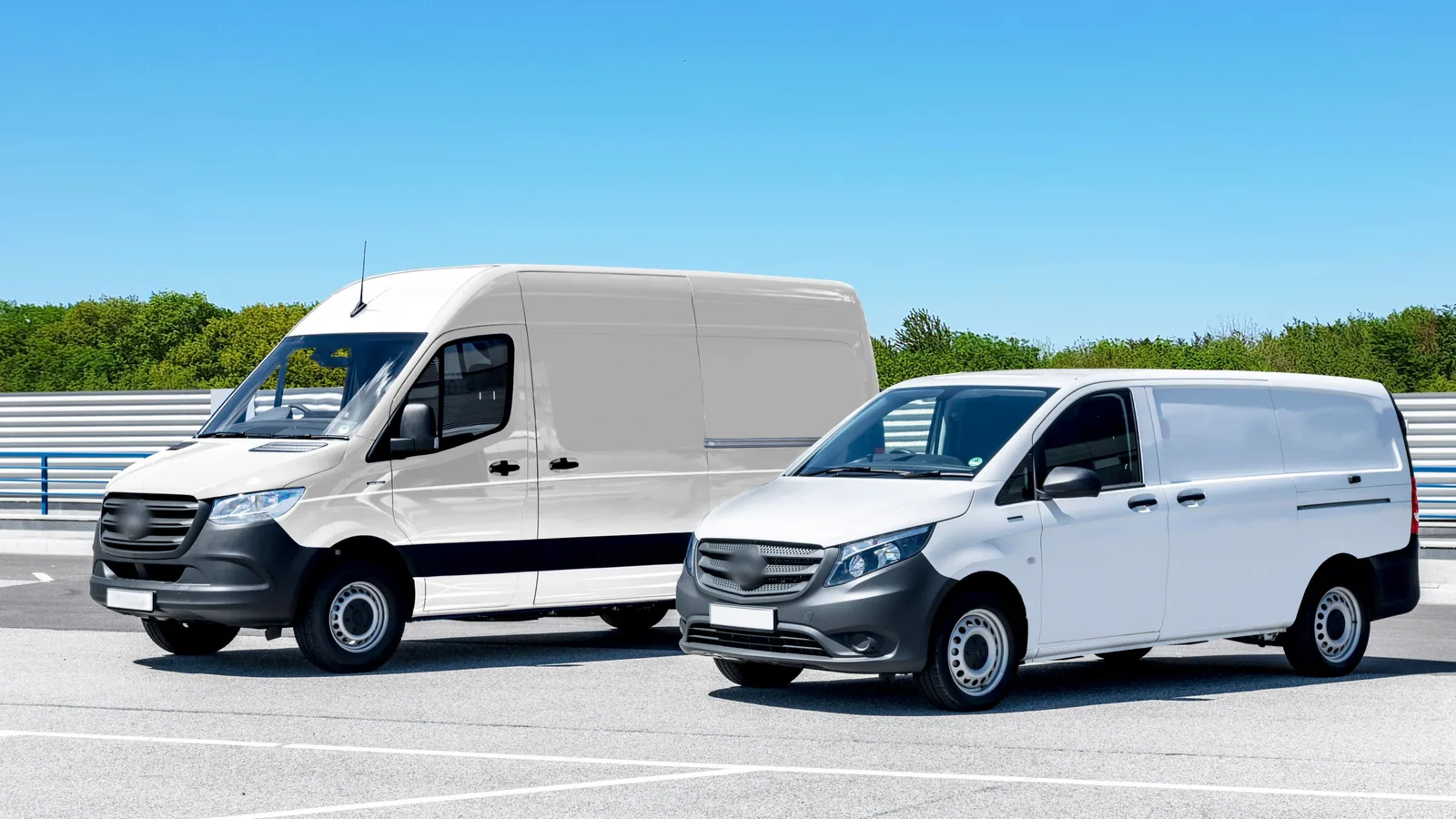
A used van does not sell like a car. Buyers look at payload, dimensions, body type and above all at the rules in their own country: registration taxes, low-emission zones, accepted Euro classes. That is why the same batch of Ducatos or Transits can be worth much more in one country than in another. Here is what is happening in 2026 and where it makes sense to offer used vans.
1. The market: diesel still dominates
In the first half of 2026, 742,759 new vans were registered in the European Union, 1.9% more than a year earlier. Diesel is still by far the leading fuel, although it is losing ground to electric and plug-in vans.
| Indicator | H1 2026 |
|---|---|
| New vans registered (EU) | 742,759 (+1.9%) |
| Diesel share | 79.1% (was 82%) |
| Electric and plug-in share | 13.2% (was 9.5%) |
| Germany | −4.6% |
| Italy | −4.7% |
| France | −2.1% |
| Spain | +7.9% |
Source: ACEA, commercial vehicle registrations H1 2026
Almost eight in ten new vans are diesel: used diesel vans still have a large market. But emission and tax rules are changing, and in some countries the room for diesel is shrinking fast.
2. Country by country: the rules that set the price
Netherlands: since 2025 the registration tax (BPM) exemption for business owners' fossil-fuel vans has been abolished. BPM is calculated on CO₂ emissions: for a new diesel van at 180 g/km it comes to roughly €14,200, while electric vans are exempt. On top of that, Euro 5 vans will no longer be allowed into Dutch cities' zero-emission zones from 1 January 2027, and vans registered from 2025 must be zero-emission. The result: the Netherlands is increasingly a country that used diesel vans leave from, rather than a market to sell them in.
Germany: new van registrations are down 4.6%, and demand for used vans remains strong. To enter environmental zones (Umweltzonen) a green sticker is needed, which diesels get from Euro 4 upwards; some cities, such as Stuttgart, have additional bans on Euro 5 and older diesels. For the German market, Euro 6 vans are the safer bet.
Poland: imported passenger cars pay excise duty, while N1 vans and light trucks up to 3.5 tonnes do not. Since 2021, however, before registering them the buyer must obtain a document from the tax office confirming that the vehicle is not subject to excise. It is one of the most receptive markets for older, higher-mileage diesel vans.
Denmark: vans have a much lower registration tax than cars: the first DKK 84,000 of value is tax-free and 50% is paid above that, plus a CO₂-related amount. This also applies to imported used vans, based on their Danish market value. A possible market for recent vans in good condition, but taxes weigh on the final price.
France: the emissions malus also applies to imported used vehicles never registered in France, but among N1 commercial vehicles it only affects those that can also be used for non-professional purposes, such as 5-seat pick-ups and vans with several rows of seats. Standard work vans are excluded.
Italy: new van registrations are also falling here (−4.7%). Many batches come from rental companies and fleets: Italy is a good sourcing market, especially for Ducato, Doblò and mid-size vans.
3. What buyers look at
Buyers of used van batches mainly assess:
Euro class: it decides which cities the van can drive in. Euro 6, and even better Euro 6d, opens up more markets.
Dimensions and version: length and height (L1H1, L2H2…), cargo or crew-cab, payload, number of seats.
N1 type approval in the COC: this is what allows, for example, avoiding excise in Poland or the malus in France.
Conversions: shelving, refrigerated bodies, flatbeds and tow bars can raise or lower the value depending on the market.
Body condition and service history: vans work hard, and a damage report with photos makes a batch much easier to sell.
Documents: for VAT, documents and transport, see our full guide.
4. In short: where to offer a batch of used vans
- Germany for recent Euro 6 vans in good condition with a full history.
- Poland and Eastern Europe for older, higher-mileage diesel vans, thanks to the absence of excise on N1 vehicles.
- Denmark for recent vans in excellent condition, taking taxes into account.
- Netherlands mainly as a sourcing market for diesel, and as a sales market for electric vans.
The price should always be checked market by market, on real listings and net of local VAT: between one country and another the same version can be worth thousands of euros more or less.
How we work
Commercial vehicles are one of our specialities: we compare every batch across the main European markets before offering it to buyers, and invoice and payment always go directly between supplier and buyer.
See the commercial vehicles we handle
Have a batch of vans to offer, or looking for vans for your market? Contact us.